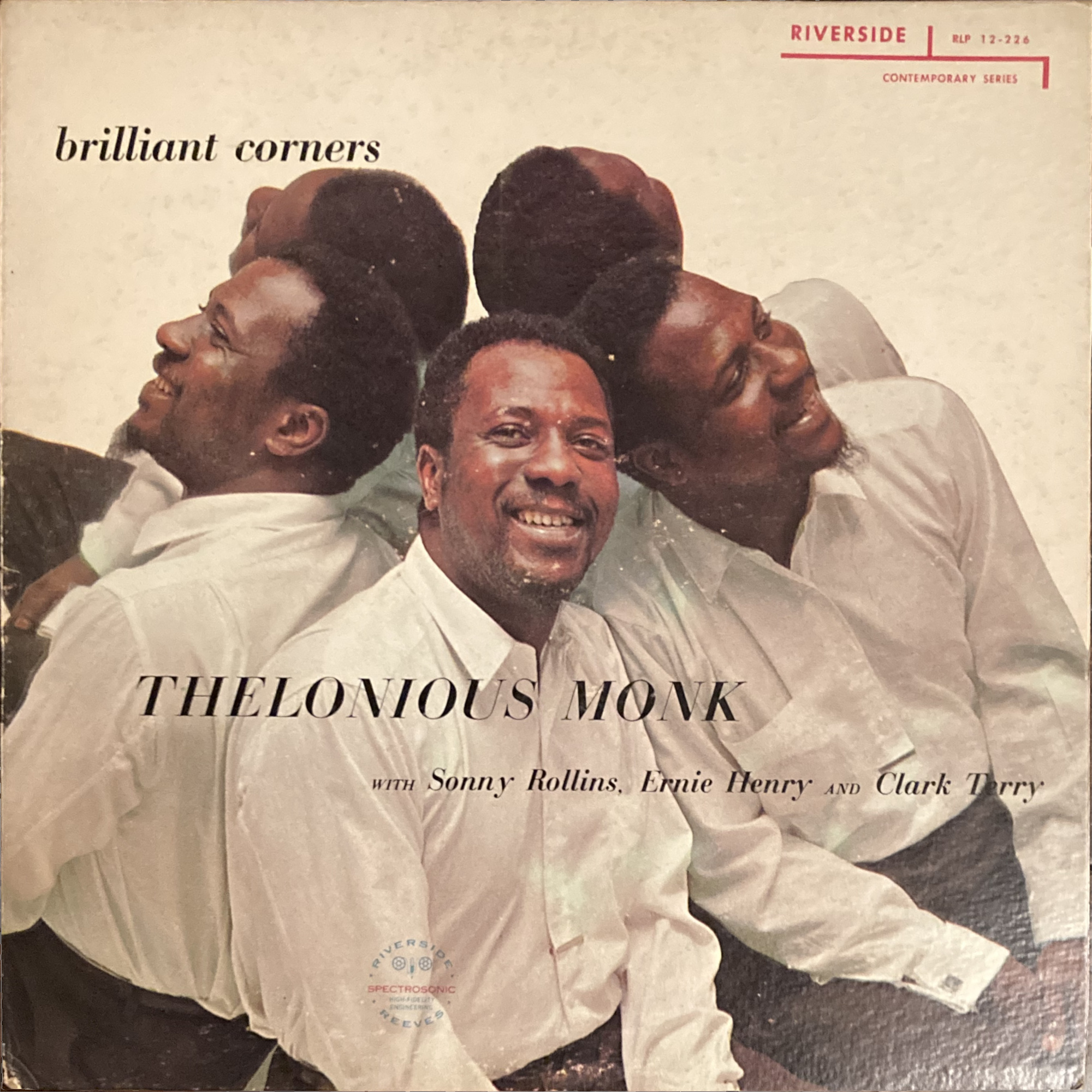

Label: RIVERSIDE
No.: RLP 12-226
Title: BRILLIANT CORNERS
Musician: THELONIOUS MONK
Recorded: 1956/10/9, 1956/10/15, 1956/12/7
Monaural
Cover address: 235 West 46th Street New York 36, N.Y.
Coating無し
Groove Guard
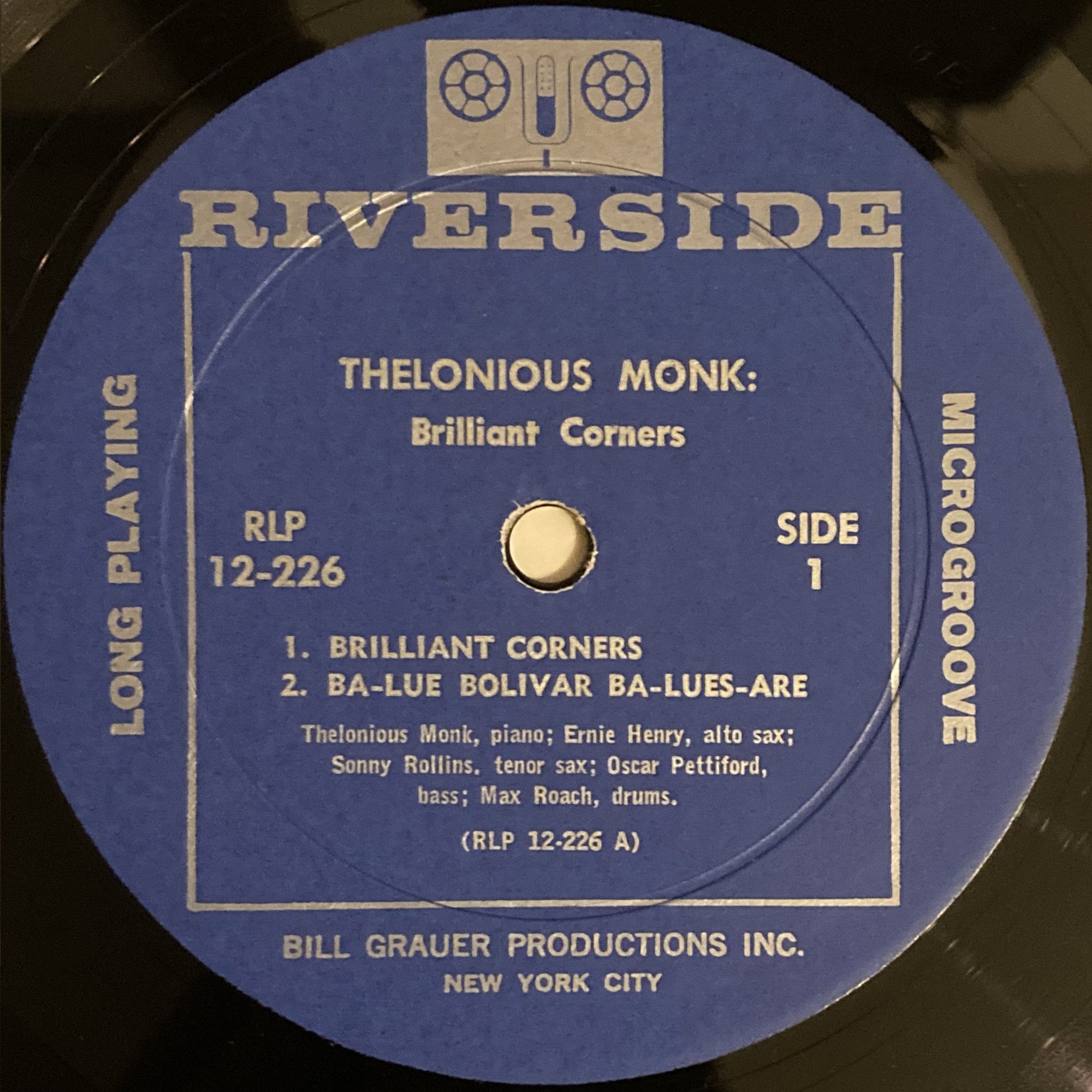
Label Side-1
Large Blue Background
Silver Letter With INC
Address: None
Deep Groove
Dead Wax Info: RLP-12-226-A2, AB
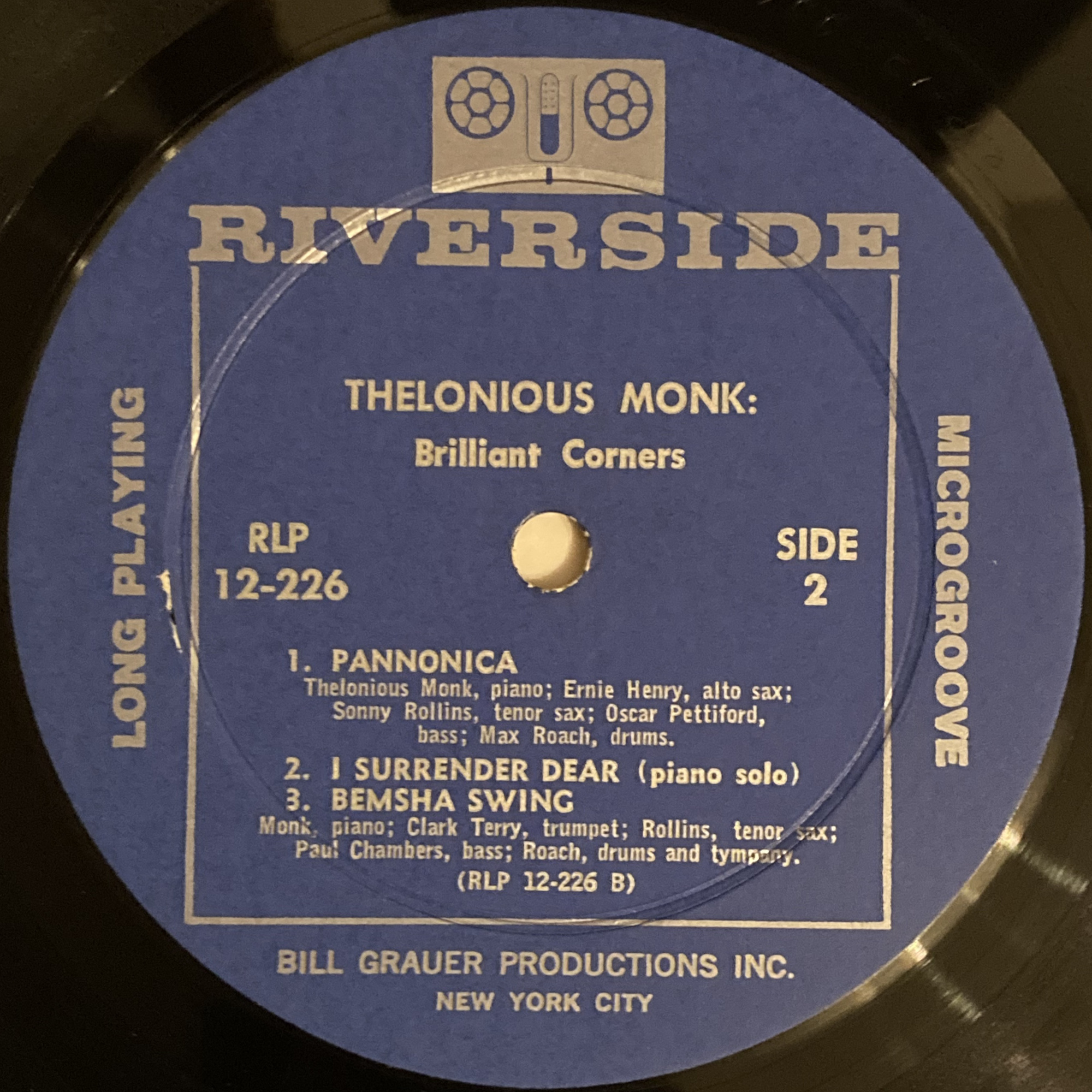
Label Side-2
Large Blue Background
Silver Letter With INC
Address: None
Deep Groove
Dead Wax Info: RLP-12-226-B2, AB
Personnel- Recorded on 1956/10/9 SIde1-(2), Side2-(1)
Drums: Max Roach
Bass: Oscar Pettiford
Piano: Thelonious Monk
Tenor Sax: Sonny Rollins
Alto Sax: Ernie Henry
Personnel- Recorded on 1956/10/15 SIde1-(1)
Drums: Max Roach
Bass: Oscar Pettiford
Piano: Thelonious Monk
Tenor Sax: Sonny Rollins
Alto Sax: Ernie Henry
Personnel- Recorded on 1956/12/7 Side2-(2)
Piano: Thelonious Monk
Personnel- Recorded on 1956/12/7 Side2-(3)
Drums: Max Roach
Bass: Paul Chambers
Piano: Thelonious Monk
Tenor Sax: Sonny Rollins
Trumpet: Clark Terry
Tracks-
Side-1
1) Brilliant Corners 7’42”
2) Ba-lue Bolivar Ba-lues-are 13’08”
Side-2
1) Pannonica 8’50”
2) I Surrender,Dear 5’25”
3) Bemsha Swing 7’42”
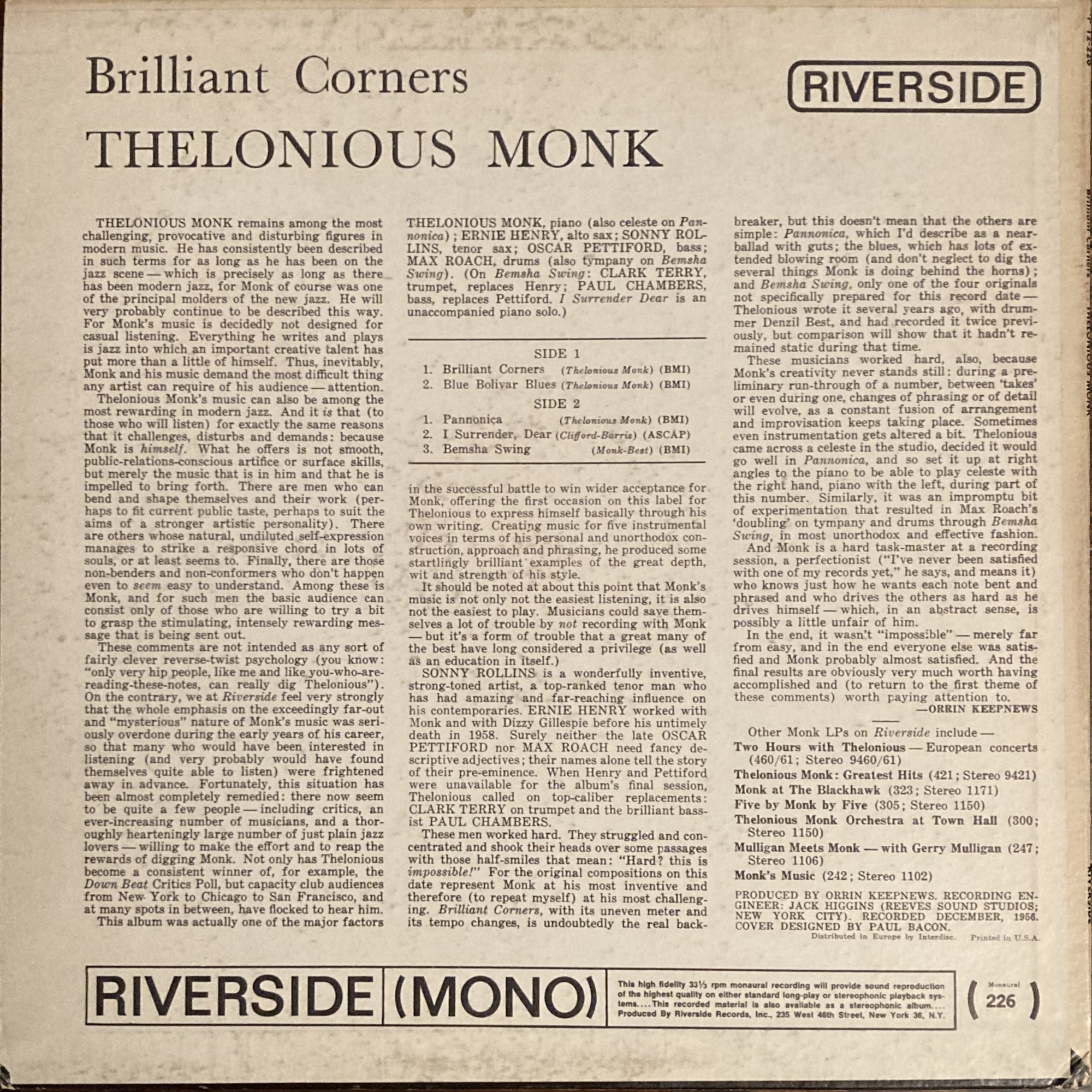
<裏ジャケ原文>
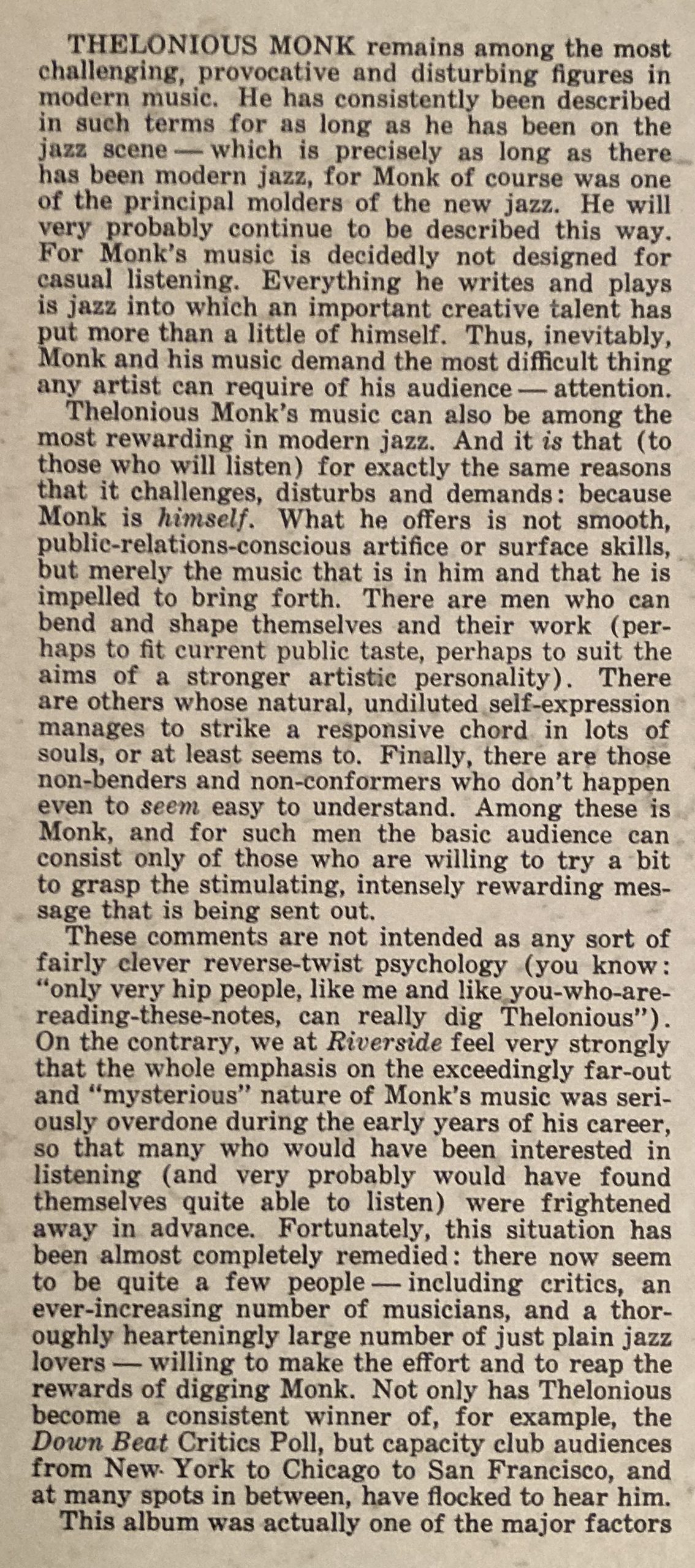
THELONIOUS MONK remains among the most challenging, provocative and disturbing figures in modern music. He has consistently been described in such terms for as long as he has been on the jazz scene which is precisely as long as there. has been modern jazz, for Monk of course was one of the principal molders of the new jazz. He will very probably continue to be described this way. For Monk’s music is decidedly not designed for casual listening. Everything he writes and plays is jazz into which an important creative talent has put more than a little of himself. Thus, inevitably, Monk and his music demand the most difficult thing any artist can require of his audience-attention. Thelonious Monk’s music can also be among the most rewarding in modern jazz. And it is that (to those who will listen) for exactly the same reasons that it challenges, disturbs and demands: because Monk is himself. What he offers is not smooth, public-relations-conscious artifice or surface skills, but merely the music that is in him and that he is impelled to bring forth. There are men who can bend and shape themselves and their work (per- haps to fit current public taste, perhaps to suit the aims of a stronger artistic personality). There are others whose natural, undiluted self-expression manages to strike a responsive chord in lots of souls, or at least seems to. Finally, there are those non-benders and non-conformers who don’t happen even to seem easy to understand. Among these is Monk, and for such men the basic audience can consist only of those who are willing to try a bit to grasp the stimulating, intensely rewarding mes- sage that is being sent out.
These comments are not intended as any sort of fairly clever reverse-twist psychology (you know: “only very hip people, like me and like you-who-are- reading-these-notes, can really dig Thelonious”). On the contrary, we at Riverside feel very strongly that the whole emphasis on the exceedingly far-out and “mysterious” nature of Monk’s music was seri- ously overdone during the early years of his career, so that many who would have been interested in listening (and very probably would have found themselves quite able to listen) were frightened away in advance. Fortunately, this situation has been almost completely remedied: there now seem to be quite a few people-including critics, an ever-increasing number of musicians, and a thor- oughly hearteningly large number of just plain jazz lovers-willing to make the effort and to reap the rewards of digging Monk. Not only has Thelonious become a consistent winner of, for example, the Down Beat Critics Poll, but capacity club audiences from New York to Chicago to San Francisco, and at many spots in between, have flocked to hear him.
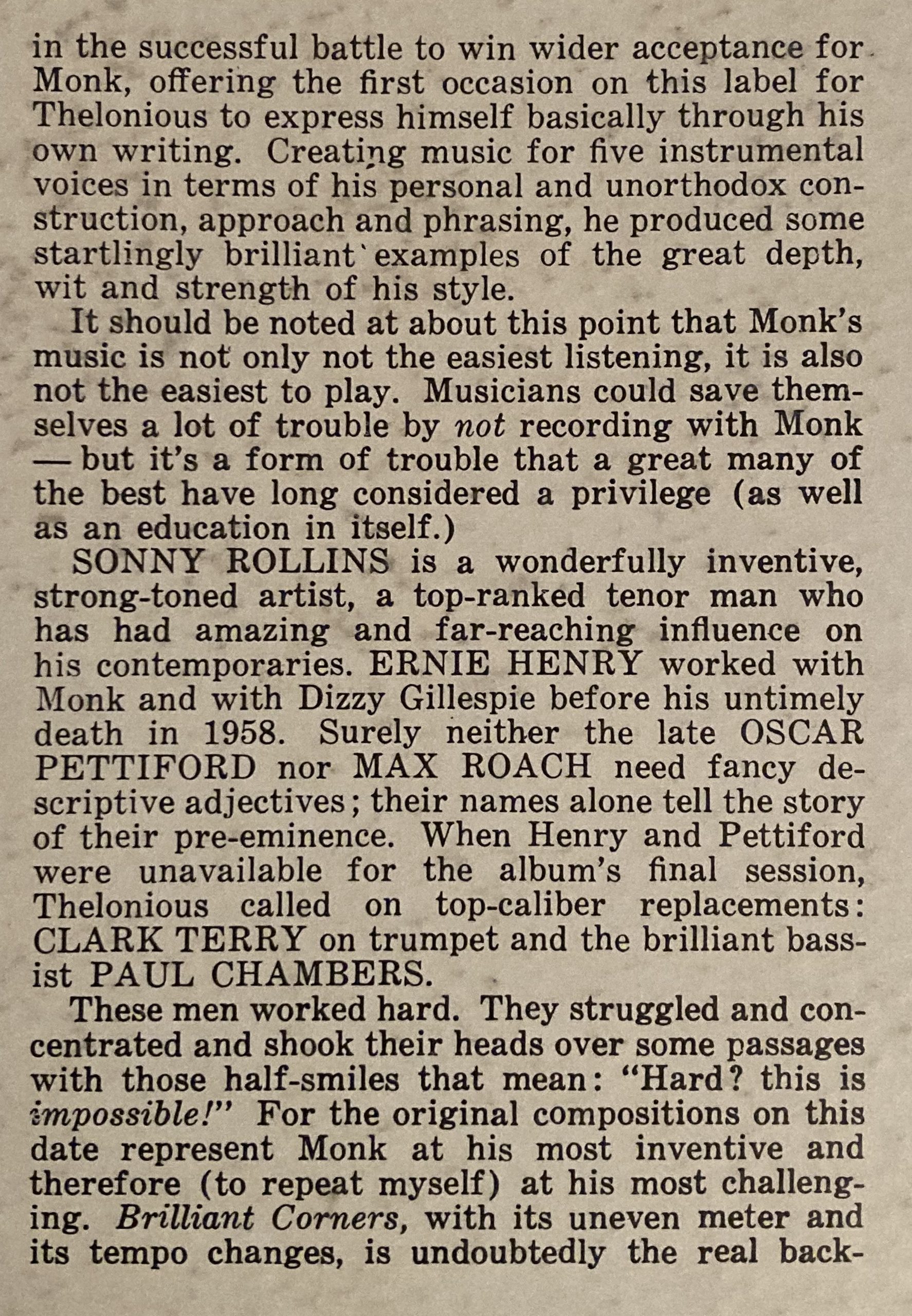
This album was actually one of the major factors in the successful battle to win wider acceptance for Monk, offering the first occasion on this label for Thelonious to express himself basically through his own writing. Creating music for five instrumental voices in terms of his personal and unorthodox con- struction, approach and phrasing, he produced some startlingly brilliant examples of the great depth, wit and strength of his style.
It should be noted at about this point that Monk’s music is not only not the easiest listening, it is also not the easiest to play. Musicians could save them- selves a lot of trouble by not recording with Monk
but it’s a form of trouble that a great many of the best have long considered a privilege (as well as an education in itself.)
SONNY ROLLINS is a wonderfully inventive, strong-toned artist, a top-ranked tenor man who has had amazing and far-reaching influence on his contemporaries. ERNIE HENRY worked with Monk and with Dizzy Gillespie before his untimely death in 1958. Surely neither the late OSCAR PETTIFORD nor MAX ROACH need fancy de- scriptive adjectives; their names alone tell the story of their pre-eminence. When Henry and Pettiford were unavailable for the album’s final session, Thelonious called on top-caliber replacements: CLARK TERRY on trumpet and the brilliant bass- ist PAUL CHAMBERS.
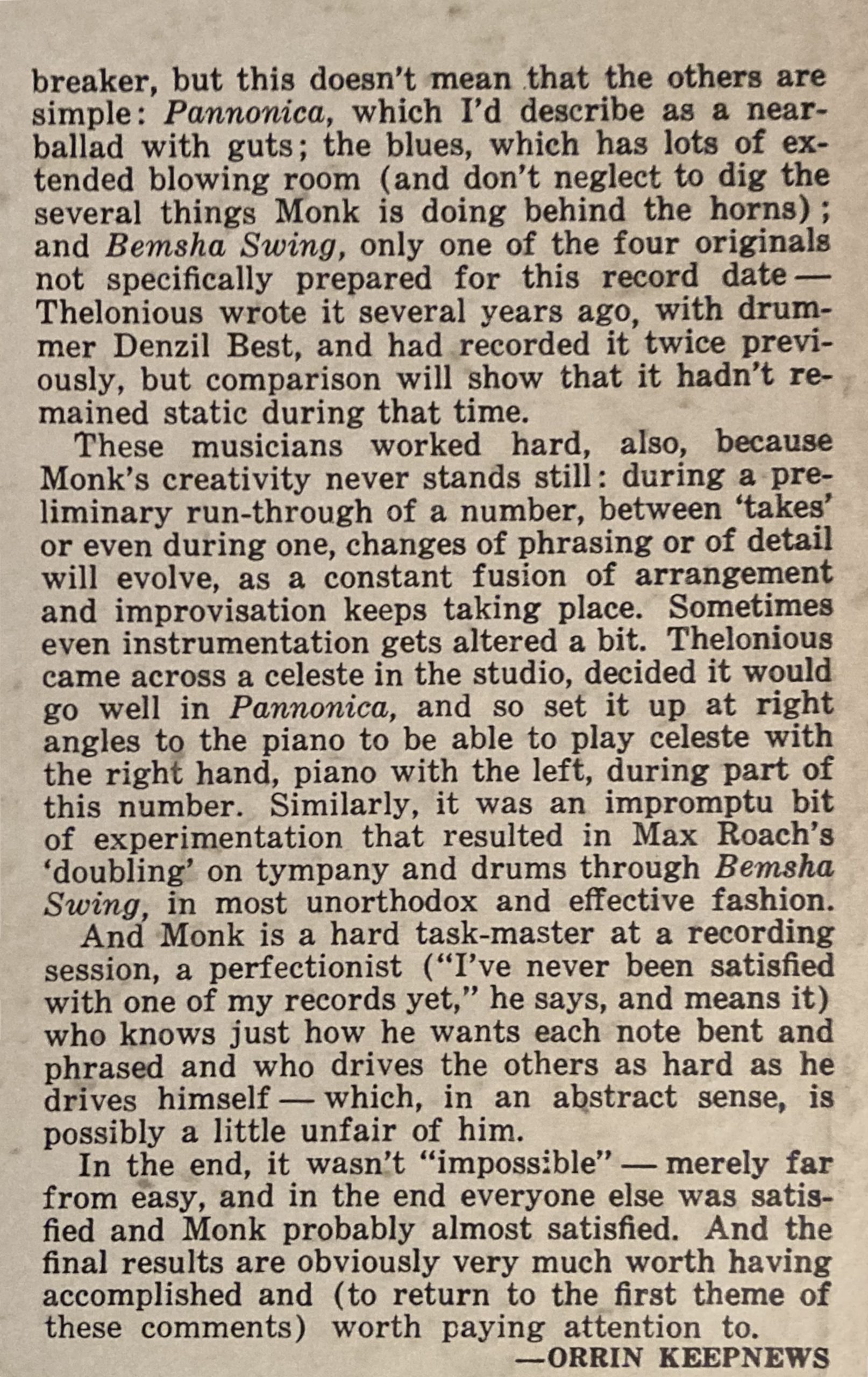
These men worked hard. They struggled and con- centrated and shook their heads over some passages with those half-smiles that mean: “Hard? this is impossible!” For the original compositions on this date represent Monk at his most inventive and therefore (to repeat myself) at his most challeng- ing. Brilliant Corners, with its uneven meter and its tempo changes, is undoubtedly the real back-breaker, but this doesn’t mean that the others are simple: Pannonica, which I’d describe as a near- ballad with guts; the blues, which has lots of ex- tended blowing room (and don’t neglect to dig the several things Monk is doing behind the horns); and Bemsha Swing, only one of the four originals not specifically prepared for this record date Thelonious wrote it several years ago, with drum- mer Denzil Best, and had recorded it twice previ- ously, but comparison will show that it hadn’t re- mained static during that time.
These musicians worked hard, also, because Monk’s creativity never stands still: during a pre- liminary run-through of a number, between ‘takes’ or even during one, changes of phrasing or of detail will evolve, as a constant fusion of arrangement and improvisation keeps taking place. Sometimes even instrumentation gets altered a bit. Thelonious came across a celeste in the studio, decided it would go well in Pannonica, and so set it up at right angles to the piano to be able to play celeste with the right hand, piano with the left, during part of this number. Similarly, it was an impromptu bit of experimentation that resulted in Max Roach’s ‘doubling’ on tympany and drums through Bemsha Swing, in most unorthodox and effective fashion.
And Monk is a hard task-master at a recording session, a perfectionist (“I’ve never been satisfied with one of my records yet,” he says, and means it) who knows just how he wants each note bent and phrased and who drives the others as hard as he drives himself – which, in an abstract sense, is possibly a little unfair of him.
In the end, it wasn’t “impossible” – merely far from easy, and in the end everyone else was satis- fied and Monk probably almost satisfied. And the final results are obviously very much worth having accomplished and (to return to the first theme of these comments) worth paying attention to. -ORRIN KEEPNEWS
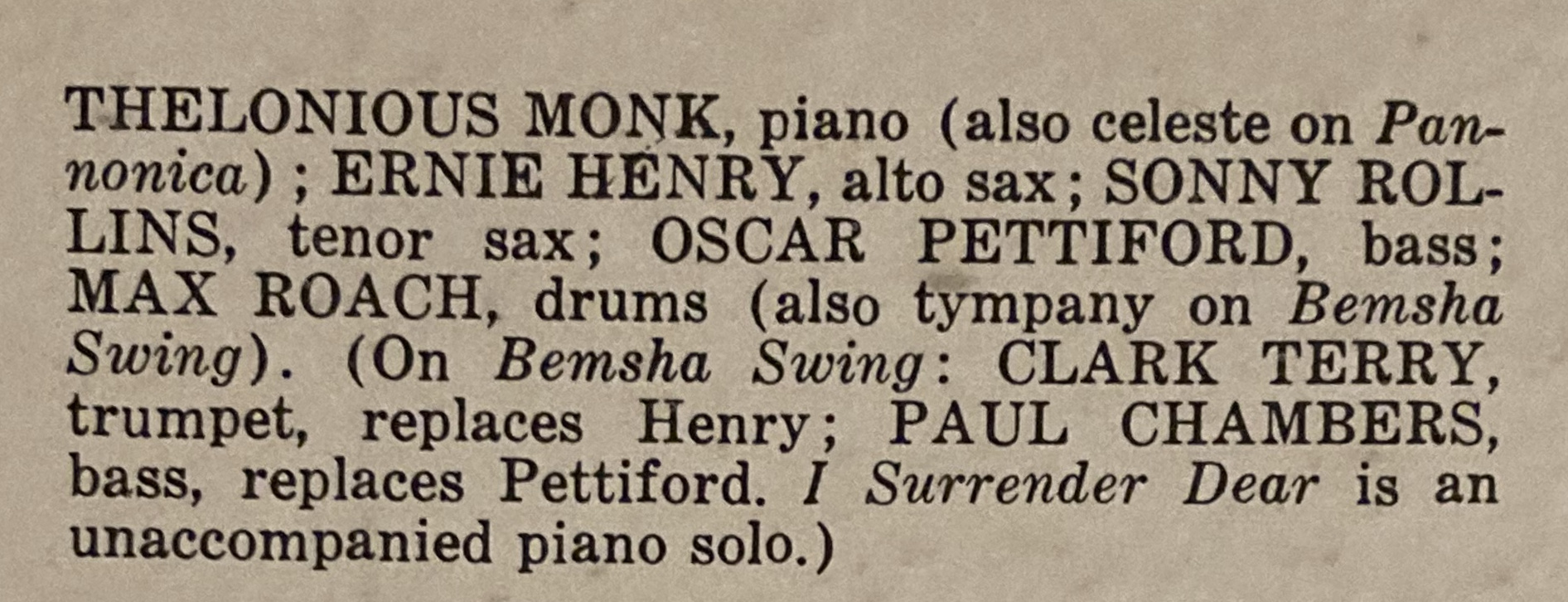
THELONIOUS MONK, piano (also celeste on Pan- nonica); ERNIE HENRY, alto sax; SONNY ROL- LINS, tenor sax; OSCAR PETTIFORD, bass; MAX ROACH, drums (also tympany on Bemsha Swing). (On Bemsha Swing: CLARK TERRY, trumpet, replaces Henry; PAUL CHAMBERS, bass, replaces Pettiford. I Surrender Dear is an unaccompanied piano solo.)
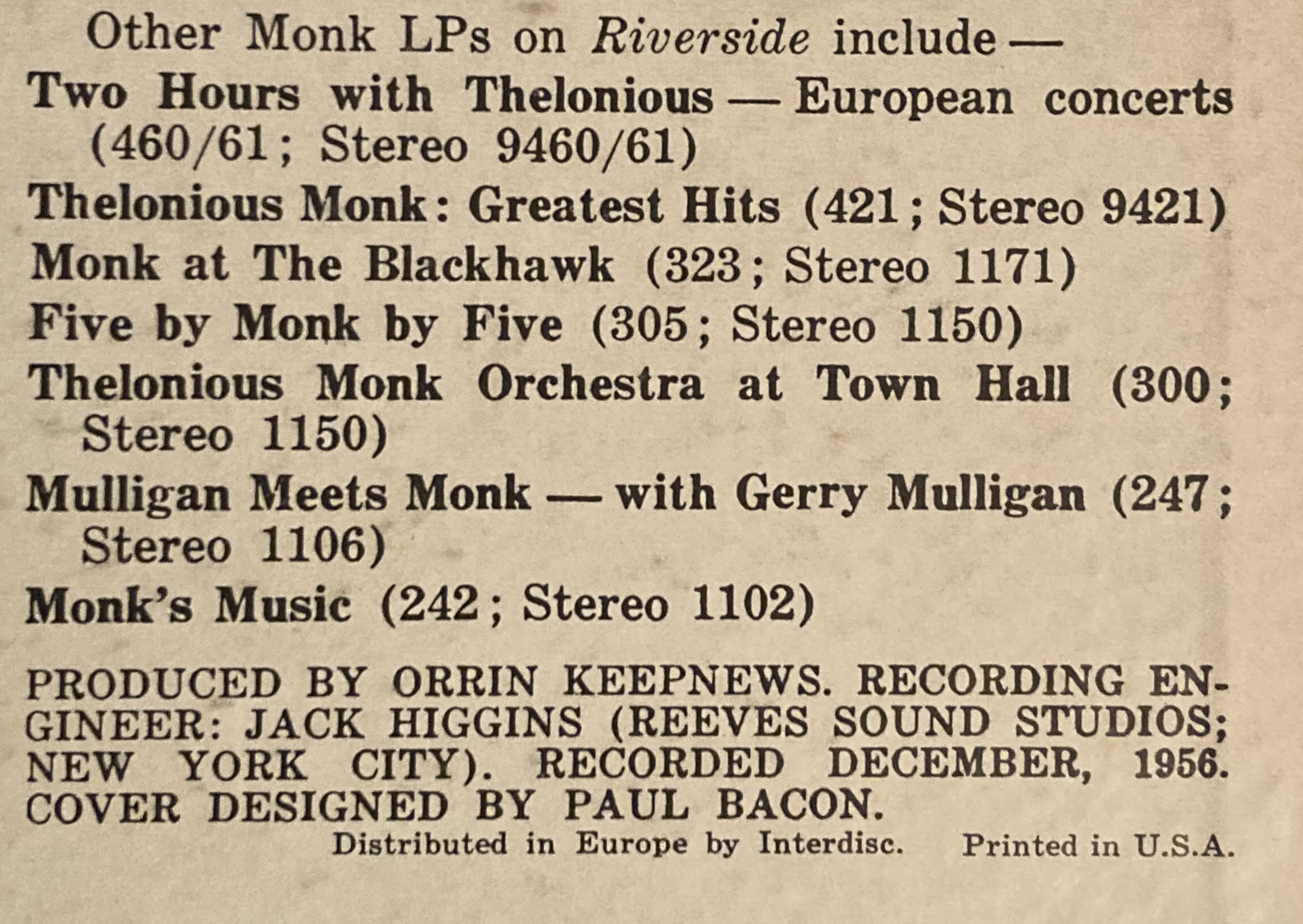
Other Monk LPs on Riverside include –
Two Hours with Thelonious – European concerts (460/61; Stereo 9460/61)
Thelonious Monk: Greatest Hits (421; Stereo 9421) Monk at The Blackhawk (323; Stereo 1171)
Five by Monk by Five (305; Stereo 1150)
Thelonious Monk Orchestra at Town Hall (300; Stereo 1150)
Mulligan Meets Monk-with Gerry Mulligan (247; Stereo 1106)
Monk’s Music (242; Stereo 1102)
PRODUCED BY ORRIN KEEPNEWS. RECORDING EN- GINEER: JACK HIGGINS (REEVES SOUND STUDIOS; NEW YORK CITY). RECORDED DECEMBER, 1956. COVER DESIGNED BY PAUL BACON.
Distributed in Europe by Interdisc.
Printed in U.S.A.
This high fidelity 333 rpm monaural recording will provide sound reproduction of the highest quality on either standard long-play or stereophonic playback sys- tems…. This recorded material is also available as a stereophonic album…. Produced By Riverside Records, Inc., 235 West 46th Street, New York 36, N.Y.
<裏ジャケ和訳>
セロニアス・モンクは、現代音楽において最も難解かつ挑発的で、聴き手に動揺を迫るような存在であり続けています。彼がジャズ・シーンに登場して以来――つまりモダン・ジャズの歴史そのものと同じだけの期間にわたり――常にそのような言葉で評されてきました。それも当然のことで、モンクこそがその新しいジャズを形作った主要な人物の一人だったからです。そして今後もおそらく、彼は同じように評され続けるでしょう。なぜなら、モンクの音楽は決して「何気なく聴き流す」ために作られたものではないからです。彼が作曲し演奏するすべての音には、その偉大な創造的才能を持つ彼自身が、少なからず注ぎ込まれています。それゆえ必然的に、モンクとその音楽は、アーティストが聴衆に求めることのできる最も困難なもの、すなわち「真剣な注意」を要求するのです。しかし同時に、セロニアス・モンクの音楽は、現代ジャズの中で最も深い充足感をもたらすものの一つでもあります。そして、彼が聴き手に挑み、動揺させ、何かを要求するのと全く同じ理由によって――つまり、モンクがあくまで「彼自身」であり続けているからこそ――その音楽は(耳を傾けようとする人々にとって)深い充足感をもたらすのです。彼が提示するのは、世間受けを狙った巧みな演出や表面的な技巧などではありません。ただ彼自身の内側にあり、彼がどうしても外へ表現せずにはいられない音楽なのです。世の中には、自分自身や自分の作品を柔軟に変えたり形作ったりできる人々がいます(おそらくは世間の流行に合わせるため、あるいはより強力な芸術的個性の意図に沿うためでしょう)。また、ありのままの純粋な自己表現によって、多くの人々の心に響く何かを伝える(あるいは少なくともそう思わせる)人々もいます。そして最後に、決して自分を曲げず、迎合もしない人々がいます。彼らは、一見したところ理解しやすそうにさえ見えないものです。モンクはその一人であり、そうした人物にとっての聴衆となり得るのは、彼らが発する刺激的で、かつ深い充足感に満ちたメッセージを理解しようと、自ら歩み寄る意志のある人々だけなのです。
これらの言葉は、何か気の利いた「逆説的な心理作戦」を意図したものではありません(よくある「俺や、この文章を読んでいる君のような、本当に『イケてる(ヒップな)』人間だけが、セロニアスの真の良さを理解できるんだ」といった類の話ではない、ということです)。それどころか、私たちリバーサイド・レコードは、モンクの音楽が持つ極めて風変わりで「謎めいた」側面ばかりが強調されすぎたために、本来なら興味を持ち、十分にその音楽を理解できたであろう多くの人々が、最初から敬遠してしまっていたと考えています。幸いなことに、こうした状況はほぼ完全に解消されました。現在では、批評家や増え続けるミュージシャン、そして何よりも心強いことに、純粋にジャズを愛する多くの人々が、モンクの音楽を深く味わおうと努め、その素晴らしさを享受するようになっています。セロニアスは『ダウン・ビート』誌の批評家投票で常に上位に選ばれるようになっただけでなく、ニューヨークからシカゴ、サンフランシスコ、そしてその間の各地に至るまで、クラブは満員の聴衆で埋め尽くされ、彼の演奏を求めて人々が押し寄せています。
このアルバムは、モンクがより広く受け入れられるようになるための重要な一歩となりました。というのも、この作品は、彼が自身の作曲した楽曲を中心に自己表現を行う機会を、当レーベルにおいて初めて提供するものだったからです。独自の型破りな構成、アプローチ、そしてフレージングを用いて5つの楽器編成のための音楽を創り上げ、彼はそのスタイルが持つ深い精神性、ウィット、そして力強さを如実に示す、驚くほど素晴らしい作品の数々を生み出しました。
ここで特筆すべきは、モンクの音楽は聴くのが容易ではないだけでなく、演奏するのも決して簡単ではないということです。ミュージシャンたちは、モンクとレコーディングしなければ、多くの苦労をせずに済んだかもしれません。しかし、その「苦労」こそが、数多くのトップ・ミュージシャンたちが長年にわたり特権(そしてそれ自体が貴重な学びの機会)だと見なしてきたものなのです。
ソニー・ロリンズは、驚くべき独創性と力強い音色を併せ持つアーティストであり、同時代のミュージシャンたちに多大かつ広範な影響を与えたトップクラスのテナー・サックス奏者です。アーニー・ヘンリーは、1958年に早すぎる死を迎えるまで、セロニアス・モンクやディジー・ガレスピーと共演していました。故オスカー・ペティフォードやマックス・ローチといった巨匠たちには、大げさな形容詞など不要でしょう。その名前だけで、彼らが傑出した存在であることが十分に伝わるからです。アルバムの最終セッションでヘンリーとペティフォードの参加が叶わなかった際、モンクは一流の代役を起用しました。トランペットのクラーク・テリーと、卓越したベーシストであるポール・チェンバースです。
彼らは懸命に取り組みました。苦心し、集中し、あるフレーズに直面しては首をかしげ、「難しい? いや、これは不可能だ!」と言わんばかりの苦笑いを浮かべることもありました。それもそのはず、このセッションで演奏されたオリジナル曲の数々は、モンクの独創性が最も発揮された作品であり、それゆえに(繰り返しになりますが)演奏者にとって極めて難易度の高いものだったからです。変拍子やテンポ・チェンジを含む「ブリリアント・コーナーズ(Brilliant Corners)」は、間違いなく最大の難所と言えますが、他の曲が単純だというわけではありません。「パノニカ(Pannonica)」は、力強さを秘めたバラードに近い曲と言えるでしょう。ブルース・ナンバーは、ソロを長く展開できる余地が十分にあり(ホーン・セクションの背後でモンクが見せる多彩なプレイにもぜひ注目してください)。そして「ベンシャ・スウィング(Bemsha Swing)」は、このレコーディングのために特別に書き下ろされたわけではない唯一のオリジナル曲です。モンクは数年前にドラマーのデンジル・ベストと共作し、すでに2回録音していましたが、それらを聴き比べれば、この曲が決して同じ形のまま留まっていなかったことがわかるはずです。
彼らが懸命に取り組まざるを得なかったもう一つの理由は、モンクの創造性が常に変化し続けていることにあります。曲の事前の通し演奏やテイクの合間、あるいは演奏の最中でさえも、フレーズや細部が変化していくのです。そこでは、アレンジと即興演奏が絶えず融合し続けているからです。時には楽器編成が少し変更されることさえあります。セロニアスはスタジオでチェレスタを見つけ、それが「パノニカ(Pannonica)」という曲に合うと考えました。そこで、曲の途中で右手でチェレスタを、左手でピアノを弾けるよう、ピアノに対して直角にチェレスタを配置したのです。同様に、マックス・ローチが「ベンシャ・スウィング(Bemsha Swing)」でティンパニとドラムを兼任(ダブリング)するという、極めて異例かつ効果的な演奏を行ったのも、即興的な試みから生まれたものでした。
モンクはレコーディング・セッションにおいて非常に厳しい指導者であり、完璧主義者でもあります(彼は「自分のレコードで満足できたことは一度もない」と公言し、本気でそう思っています)。彼は、どの音をどう「曲げ(ベンドさせ)」、どうフレージングすべきかを熟知しており、自分自身を追い込むのと同じ厳しさで他のメンバーにも接します――もっとも、抽象的な意味で言えば、それは彼なりの少しばかり「不公平」なやり方だったのかもしれませんが。
結局のところ、それは「不可能」なことではありませんでした。ただ、決して容易なことでもなかったのです。最終的には他の全員が満足し、モンクもおそらく、ほぼ満足したことでしょう。そして完成した作品は、苦労して成し遂げただけの価値が十分にあり、――冒頭の話題に戻るならば――注目に値するものであることは明らかです。――オリン・キープニュース
セロニアス・モンク(ピアノ/「パノニカ」ではチェレスタも担当)、アーニー・ヘンリー(アルト・サックス)、ソニー・ロリンズ(テナー・サックス)、オスカー・ペティフォード(ベース)、マックス・ローチ(ドラムス/「ベンシャ・スウィング」ではティンパニも担当)。(「ベンシャ・スウィング」では、ヘンリーに代わりクラーク・テリーがトランペットを、ペティフォードに代わりポール・チェンバースがベースを担当。「アイ・サレンダー・ディア」はピアノ・ソロ。)
その他のリバーサイド・レーベルのモンク作品:
『Two Hours with Thelonious – European concerts』(460/61; ステレオ 9460/61)
『Thelonious Monk: Greatest Hits』(421; ステレオ 9421)
『Monk at The Blackhawk』(323; ステレオ 1171)
『Five by Monk by Five』(305; ステレオ 1150)
『Thelonious Monk Orchestra at Town Hall』(300; ステレオ 1150)
『Mulligan Meets Monk』(ジェリー・マリガンとの共演)(247; ステレオ 1106)
『Monk’s Music』(242; ステレオ 1102)
プロデュース:オリン・キープニュース。録音エンジニア:ジャック・ヒギンズ(ニューヨーク、リーブス・サウンド・スタジオ)。録音:1956年12月。ジャケット・デザイン:ポール・ベーコン。
欧州での販売元:Interdisc。
米国製。
本盤は高忠実度(ハイ・フィデリティ)の33 1/3回転モノラル録音であり、標準的なLP再生システムでもステレオ再生システムでも最高品質の音質でお楽しみいただけます……本作品はステレオ・アルバムとしても発売されています……制作:Riverside Records, Inc.(所在地:235 West 46th Street, New York 36, N.Y.)
※訳文の制作にはGoogleドライブとGoogle翻訳のお世話になりました。
コメント